We’re investing in a major upgrade of our train fleet to bring you smoother, more reliable and better journeys.
This programme includes extensive improvements to our existing trains, along with the procurement of a brand new Metro fleet to replace some of our older trains.
Take a look below to discover how these upgrades will enhance your experience across our network.
The target
Better Metro: We have 30 of our modern City Beam trains in service, offering lighter, brighter and more spacious journeys across south east London and Kent. We’re also planning to add accessible toilets to these trains to make travelling easier for everyone. Alongside this, all 36 of our Class 376 trains are receiving a full interior and exterior refresh. Read about the first upgraded trains which entered service in November 2025, more refreshed trains will be rolling out throughout 2026 and into 2027.
Better Mainline: Your Mainline journeys are getting an upgrade too. The Class 375 refresh, completed in 2024, introduced at seat charging and USB sockets for the first time so you can stay powered up on the go. And in December 2025, we welcomed 13 newer Class 377 trains, featuring modern interiors, power points and air conditioning for a more comfortable ride.
Better Highspeed: We’re also enhancing your Highspeed experience. The first phase of the Class 395 upgrade finished in 2025, bringing new carpets, redesigned seats, energy efficient LED lighting and at seat USB charging to all 29 trains. Phase two is now underway, introducing improved passenger information systems and a stylish new exterior design.
The fleet improvement programme
Metro trains
Southeastern announced an important step towards delivering a multi-million pound investment to improve our fleet of Metro trains.
Across our network, we are working with our partners at Network Rail, to improve performance, expand our timetable, enhance our stations and increase the number of staff available.
The final piece of the jigsaw will be the replacement of our aging metro fleet.
Southeastern is inviting competitive offers for new, refurbished or modern cascaded rolling stock for the benefit of customers and taxpayers. In this video our Managing Director explains the potential benefits of new rolling stock for our customers.
This could be the largest investment in the Southeastern network since the introduction of the highspeed service in 2009 and is a key part of Southeastern goal of building a better, more reliable and sustainable railway.
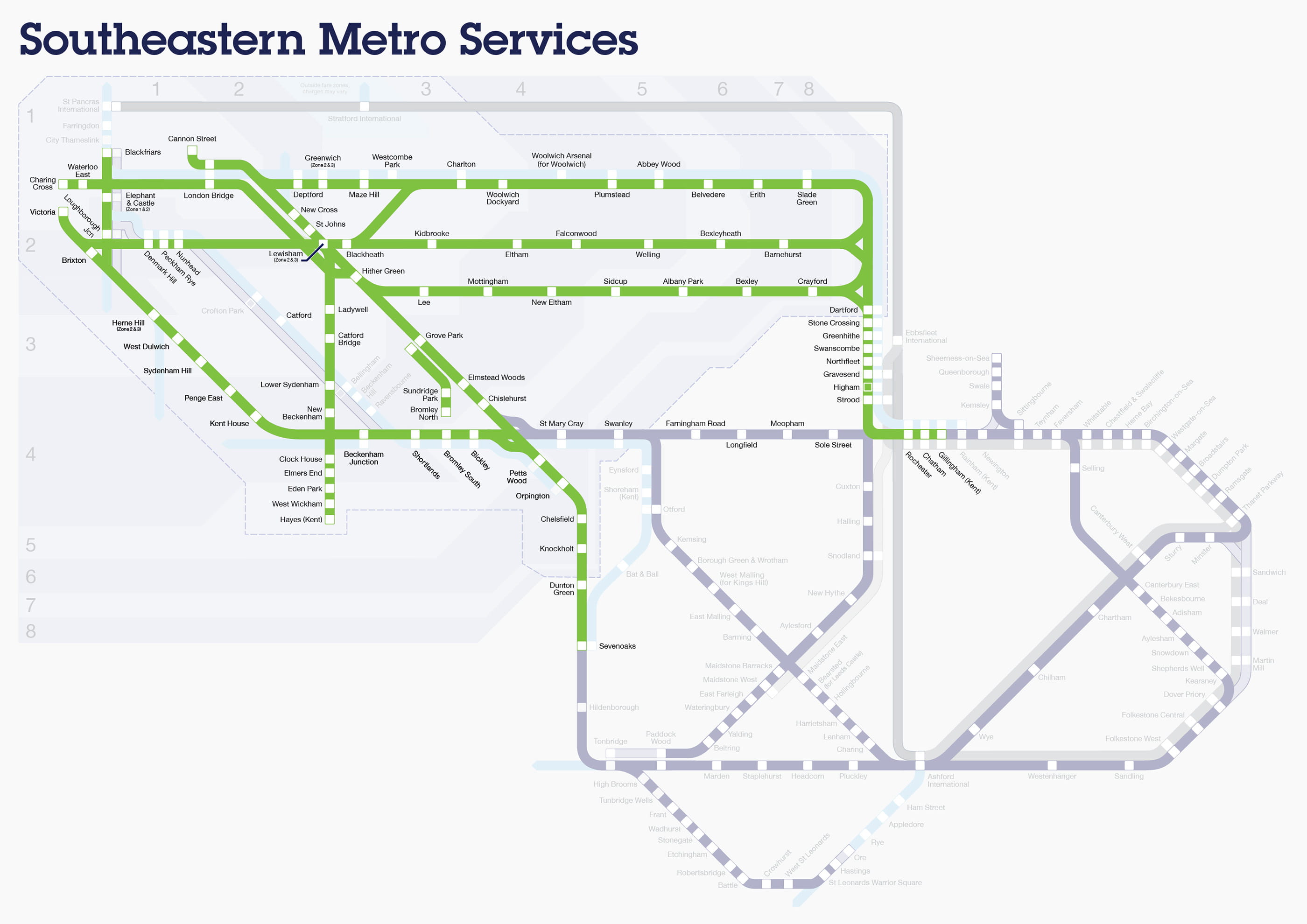
These trains would run on our Metro routes to London terminals across south east London as well as selected locations in Kent including Dartford, Sevenoaks, Grove Park and Gillingham.
The precise details of the improved fleet will be developed during the next stage of the procurement process but improvements could include:
Improved accessibility to maximise unassisted boarding – developed alongside the RSSB, Network Rail and manufacturers
Brighter and more spacious interiors to provide more space for more customers on our growing railway
Improved air conditioning to provide a better and more comfortable environment, particularly as our summers become warmer
Improved customer information to keep customers up to date and help them to plan any onward journeys
More reliable trains with improved acceleration and braking to help deliver a more punctual and low cancellation railway
Equipped with batteries to keep trains running in the event of power supply failure as well as enhancing safety in stations, depots and sidings
The City Beam (Class 707)
The City Beam was introduced onto our network in 2021 and these light, bright and spacious trains have proved to be very popular. We now have 30 five-car trains available for service on the Dartford, Hayes, and Grove Park routes. We are also retrofitting accessible toilets onto all of these trains for added customer comfort.
Having a full fleet of 30 City Beams means that even more customers on our busier Metro routes will be able to enjoy travelling on our newest trains.
Our fast trains – Highspeed (Class 395)
The Class 395 operates on our two highspeed routes from London St Pancras via Ashford and via Ramsgate. In partnership with our project partners, Eversholt Rail, and Hitachi Rail we’ve carried out a £27m upgrade of the 29 trains in the fleet.
This upgrade will future proof the UK’s only highspeed passenger fleet, which has already delivered record levels of reliability, customer satisfaction and a £1 billion+ boost to the Kent tourism economy since 2009.
The £27m improvement programme included:
Full interior refresh, with new carpets, new seats and change to the layout that will assist people with reduced mobility.
Power points for using mobiles and laptop on the go.
Enhanced LED lighting.
Extra CCTV for on-board safety and to monitor space availability.
Phase two is now underway, introducing improved passenger information systems and a stylish new exterior design.
When the full upgrade is complete, the Class 395 fleet will meet the very latest standards, giving you the best in comfort, accessibility and on board information.
Watch a short video about the first phase of the Highspeed Class 395 refresh:
Our star trains – Electrostars (Class 375, 376 & 377)
All 112 of the Class 375 ‘Electrostar’ trains that operate on our routes serving Kent, East Sussex and mainline London stations have been fitted with at-seat power sockets, USB points and new LED lighting.
The power sockets mean you can work or browse on the move, without worrying about running down the battery on your device.
We are also adding at-seat power and USB sockets to our Class 376 fleet as part of a mid-life refresh. In addition, all 36 trains are getting energy efficient LED lighting, an interior paint plus refurbished seats, and a new, blue exterior wrap.
You can watch a video about the Class 376 upgrade below:
More Class 377s have also joined our fleet. An additional 13 trains are now in service providing a more reliable service and a better travel experience with their air conditioning, at-seat power sockets, and improved onboard information.
We need to replace a significant proportion of our older train fleet, which is becoming more difficult and expensive to maintain and also lacks modern accessibility and customer facilities.
Our oldest trains are known as Networkers and were first introduced into passenger service in 1992 – the same year the Ford Escort was the country’s best-selling car.
You wouldn’t typically keep a car for that long – and our trains cover tens of thousands of miles every year.
As well as the better journeys for customers; improving the fleet will also be better value for money to taxpayers as it would reduce maintenance and lease costs and, in time, encourage more people to travel by train.
We are clear that any new or replacement trains must improve customer accessibility and help to remove barriers for everyone to travel by train.
Those bidding to manufacture new trains have been tasked with showing how they would provide level access and/or unassisted boarding at stations across the Southeastern network as defined in the Persons of Reduced Mobility (PRM) National Technical Specification Notices (NTSN).
The precise details of how this can be achieved will be developed as part of the procurement process. However, to ensure we provide the best possible solution for our customers, we are already working with the following:
Network Rail – Owners and maintainers of the railway infrastructure, including tracks and platforms
Rail Safety and Standards Board (RSSB) – The railway’s independent safety, standards and research body
Manufacturers
Our Metro fleet must be able to safely and reliably call at over 200 platforms across our network. However, as our railway has been built over many years to different standards our platforms vary in height between location and some platform heights vary from one end to the other. In addition, some are curved which can increase the distance between the train and the platform edge, too.
Improving accessibility, particularly the introduction of level access and/or unassisted boarding is a challenge for the whole railway system – but it is a challenge we are working to overcome.
We recognise much of the current fleet is tired and in need of upgrading. As such, we are working with urgency.
We have started a formal procurement process with a number of manufacturers, financiers and leasing companies to assess the available options to replace some or all of our Metro fleet of trains.
As and when more information is available, we will ensure our people, stakeholders and customers are informed accordingly.
We already operate an entirely electric train fleet however upgraded or newer trains are typically more energy efficient and will therefore further reduce Southeastern’s carbon emissions and form a key part of Southeastern’s Sustainability Strategy.
Southeastern is a publicly owned, not-for-dividend train operator.
The vast majority of trains in the UK are leased from rolling stock owning companies (ROSCOs), in much the same way as you may lease a new car. Which ever option is taken forward in the procurement, it is expected they would be funded in a similar way.
We have started a formal procurement process with a number of manufacturers, financiers and leasing companies to assess the available options to replace some or all of our trains which operate on our London metro routes and into some parts of Kent.
As and when more information is available, we will ensure our people, stakeholders and customers are informed accordingly.
No. There is no need to replace the Main Line or highspeed train fleets and they have received major updates as part of our train improvement programme.



 Ashford International to London St Pancras